
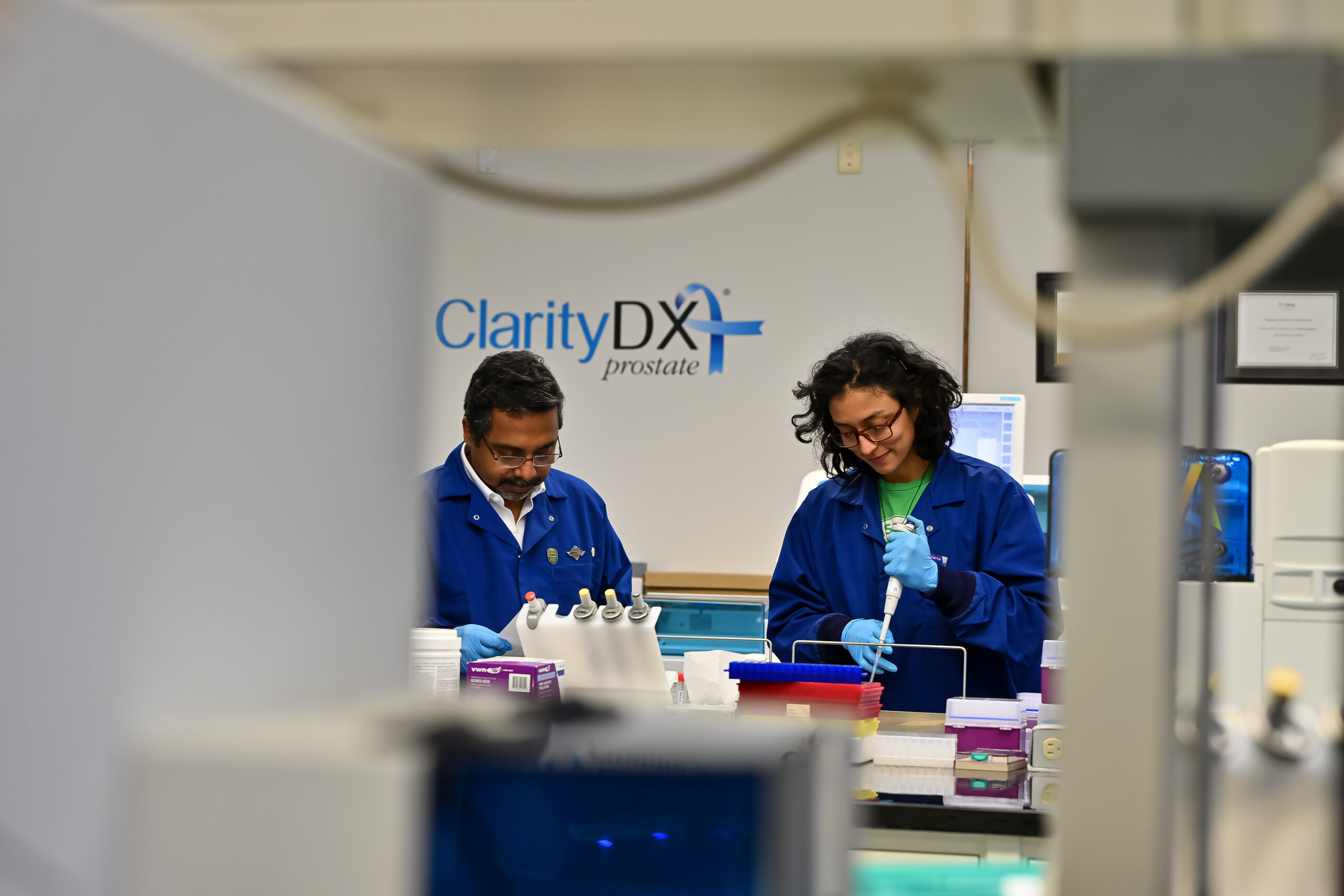
Nanostics Clinical Laboratory. Photo credit: Adam Becker, Intercept Photography
The “Trade Heroes” series highlights Edmonton region companies who have ‘EXPORT-itude‘ — By Amanda Sparks at Edmonton Global.
22% of all new cancer cases in Canadian men are prostate cancer; and when it comes to prostate cancer, early detection saves lives. Since its founding in 2017, Edmonton region-based health tech company Nanostics has been working to make its early prostate cancer detection test available across Canada, the United States, and the Middle East.
“My goal from the very beginning of my career was to try to make an impact on human disease, specifically in cancer,” John Lewis, co-founder and Chief Executive Officer of Nanostics, said.
That vision sharpened as John and his team began tackling one of medicine’s biggest diagnostic gaps: prostate cancer. “Prostate cancer that stays in the prostate is pretty much 100% curable,” he explained. “But if it spreads, it’s a deadly disease.”
The standard screening tool is the prostate-specific antigen (PSA) test. The PSA test, while widely used, is not ideal, John explained. “It really is one of the worst tests, because 75% of the time you get a high PSA, it’s not cancer … The only way to tell if you have cancer is through a biopsy, which is incredibly invasive and can come with its own side effects.”
John and his team started looking for a way to, as non-invasively as possible, “do a better job of predicting who has aggressive prostate cancer, before doing a prostate biopsy.”
To do that, Nanostics began by gathering retrospective biofluid samples and clinical data from nearly 4000 Alberta men and used this data to develop the AI-based ClarityDX Prostate test. The test was then validated using real-world blood samples and clinical data from a 3,600-patient international study in collaboration with partners in the U.S. and Europe.
“The fact that we have 4.5 million people under a single healthcare system made this project doable in Alberta,” John said. “It really couldn’t have been done anywhere else.”
“From the samples, we were able to improve the predictability of aggressive prostate cancer by three to four times,” John added. “We found we could avoid as many as half of the biopsies, just by using our scalable, AI-based test during the screening process.”
Those insights became ClarityDX Prostate, a blood test that can determine a patient’s risk of having clinically significant prostate cancer, helping patients and their physicians make more informed decisions.
The test, currently available as a patient-pay test, first became available at the company’s clinical lab in the Edmonton region and the rest of Alberta in late 2023. Availability in British Columbia, Saskatchewan, Ontario, and Quebec came the following summer — and by the end of 2024, Nanostics had announced its plans to expand to the Middle East and the U.S.
Expanding diagnostic testing across international borders comes with its own set of challenges — particularly when it comes to managing patient data. “There are certainly challenges in each jurisdiction,” John said, referring to strict privacy regulations that require health data to remain within the country where it’s collected.
Reimbursement and regulatory approval are two milestones that John believes will help the test reach new heights.
“There’s a certain percentage of the population that will pay for better information, but once you get reimbursement, then it isn’t even a question. It just becomes part of the standard of care,” John said.
On the regulatory front, Nanostics is running a clinical utility study and is aiming for FDA approval in the United States by early next year.
Looking ahead, Nanostics plans to widen its impact with new diagnostics — starting with a bladder cancer test in development, expanding into other cancers as well as conditions like dementia and Alzheimer’s.
“We began by developing a test for prostate cancer, but think of ClarityDX as the “AI layer” that turns a standard blood test into a smart diagnostic platform to bring clarity and improve decision-making across multiple diseases.”