
Monthly Archives: June 2023

EV-Fingerprint test predicts aggressive prostate cancer

Published 17 June 2023

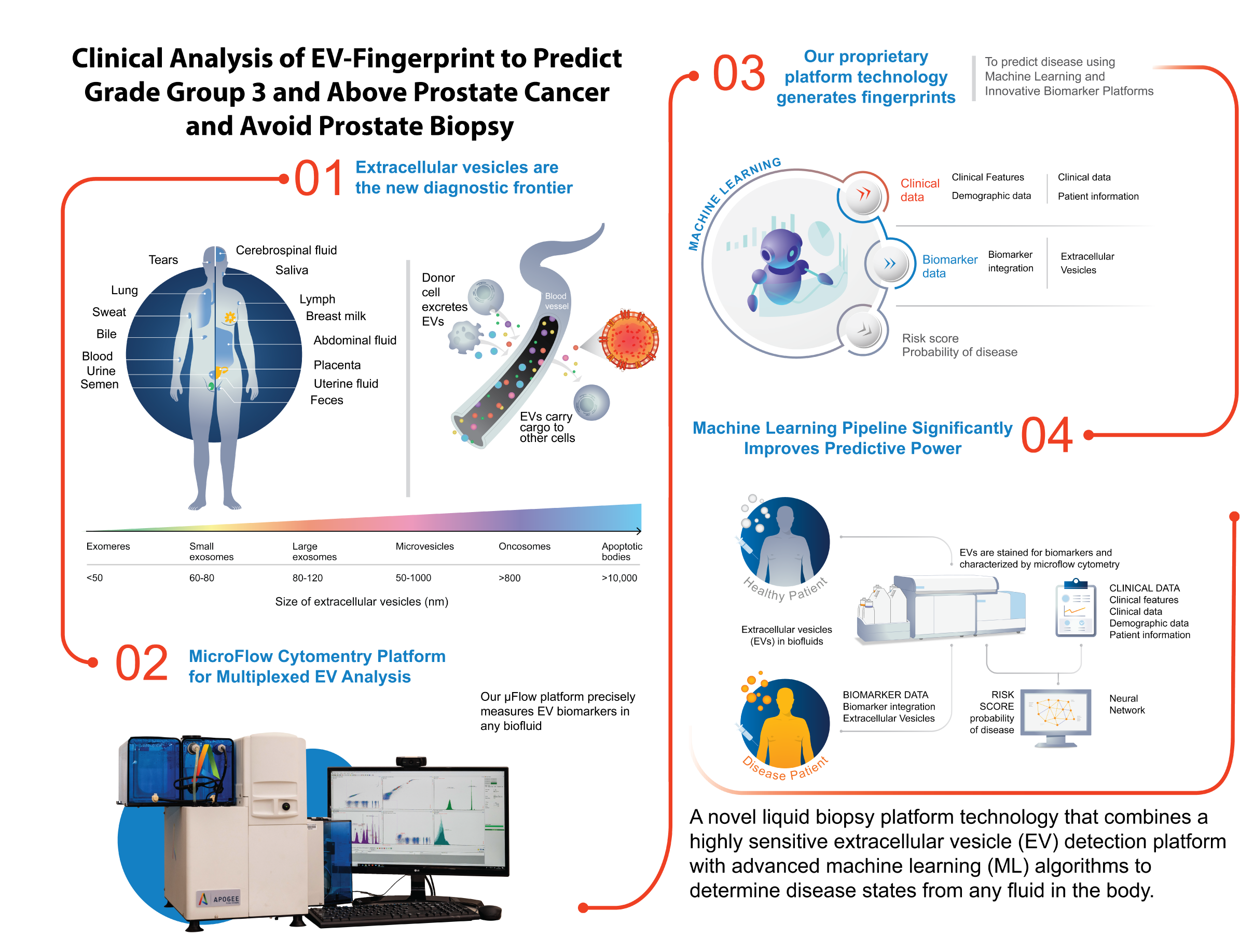
Clinical analysis of EV- Fingerprint to predict grade group 3 and above prostate cancer and avoid prostate biopsy

Adrian FaireyRobert J. PaproskiDesmond PinkDeborah L. SosnowskiCatalina VasquezBryan DonnellyEric HyndmanArmen AprikianAdam KinnairdPerrin H. BeattyJohn D. Lewis

Abstract
There is an unmet clinical need for minimally invasive diagnostic tests to improve the detection of grade group (GG) ≥3 prostate cancer relative to prostate antigen-specific risk calculators. We determined the accuracy of the blood-based extracellular vesicle (EV) biomarker assay (EV Fingerprint test) at the point of a prostate biopsy decision to predict GG ≥3 from GG ≤2 and avoid unnecessary biopsies.
This study analyzed 415 men referred to urology clinics and scheduled for a prostate biopsy, were recruited to the APCaRI 01 prospective cohort study. The EV machine learning analysis platform was used to generate predictive EV models from microflow data. Logistic regression was then used to analyze the combined EV models and patient clinical data and generate the patients’ risk score for GG ≥3 prostate cancer.
The EV-Fingerprint test was evaluated using the area under the curve (AUC) in discrimination of GG ≥3 from GG ≤2 and benign disease on initial biopsy. EV-Fingerprint identified GG ≥3 cancer patients with high accuracy (0.81 AUC) at 95% sensitivity and 97% negative predictive value. Using a 7.85% probability cutoff, 95% of men with GG ≥3 would have been recommended a biopsy while avoiding 144 unnecessary biopsies (35%) and missing four GG ≥3 cancers (5%). Conversely, a 5% cutoff would have avoided 31 unnecessary biopsies (7%), missing no GG ≥3 cancers (0%).
EV-Fingerprint accurately predicted GG ≥3 prostate cancer and would have significantly reduced unnecessary prostate biopsies.

Cytometry Part A: Antibody titrations are critical for microflow cytometric analysis of extracellular vesicles

TECHNICAL NOTE

Optimization of flow cytometry assays for extracellular vesicles (EVs) often fail to include appropriate reagent titrations – the most critically antibody titration is either not performed or is incomplete. Using nonoptimal antibody concentration is one of the main sources of error leading to a lack of reproducible data. Antibody titration for the analysis of antigens on the surface of EVs is challenging for a variety of technical reasons. Using platelets as surrogates for cells and platelet-derived particles as surrogates for EV populations, we demonstrate our process for antibody titration, highlighting some of the key analysis parameters that may confound and surprise new researchers moving into the field of EV research. Additional care must be exercised to ensure instrument and reagent controls are utilized appropriately. Complete graphical analysis of positive and negative signal intensities, concentration, and separation or stain index data is highly beneficial when paired with visual analysis of the cytometry data. Using analytical flow cytometry procedures optimized for cells for EV analysis can lead to misleading and nonreproducible results.

Nanostics Announces New Medical Laboratory Director Todd McMullen

EDMONTON, ABJune 13, 2023 /CNW/ – Nanostics Inc., a precision health company developing diagnostic tests with its ClarityDX® platform technology, announced today the appointment of Dr. Todd McMullen as the company’s new Medical Laboratory Director. In this role, Dr. McMullen will lead the accreditation and future operations of Nanostics’ new clinical laboratory in Edmonton, Alberta, Canada. Opening in the summer of 2023, Nanostics’ clinical laboratory will provide testing services to support the Canadian market.

Dr. McMullen received his M.D. from the University of Toronto and his Ph.D. in Biochemistry from the University of Alberta. Todd brings more than 25 years of academic research and medical directorship experience across multiple disease areas to Nanostics. He will support the strategy, direction, and execution of Nanostics’ clinical development programs and lead its medical affairs activities.

“We welcome Todd McMullen as Nanostics’ Medical Laboratory Director. Todd’s experience and insights will be invaluable as we launch our prostate cancer test, ClarityDX Prostate,” said John Lewis, CEO of Nanostics. “Prostate cancer remains one of the leading causes of cancer-related deaths in men, and we have shown that ClarityDX Prostate can improve patient care by more accurately identifying men with clinically significant prostate cancer.”

The appointment comes on the heels of exciting momentum for Nanostics as it readies for the launch of its ClarityDX Prostate® test to accurately detect clinically significant prostate cancer in men with elevated PSA levels. ClarityDX Prostate uses a proprietary algorithm that combines data from biological and clinical biomarkers to generate a risk score for clinically significant prostate cancer. The ClarityDX Prostate test is intended to be used by men with elevated levels of PSA and is designed to help physicians and patients make a more informed decision on whether or not to proceed with a biopsy.

Go to Top